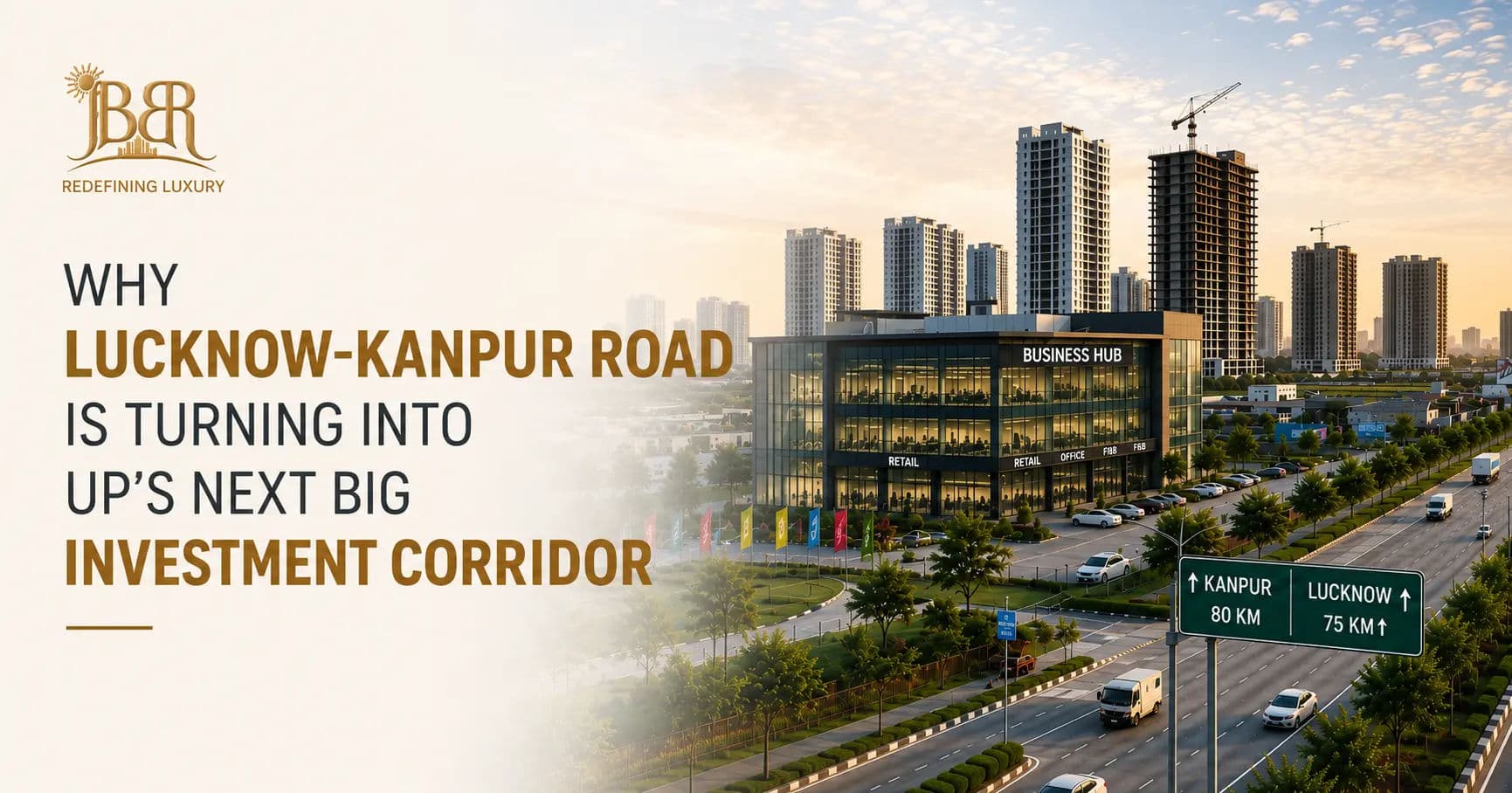
If you have been tracking real estate in Uttar Pradesh, you have probably noticed one location coming up again and again in investor conversations: Kanpur Road. What used to be a quiet stretch connecting two major cities is now shaping up as one of the strongest Lucknow-Kanpur Road investment zones in the state, and there are solid, on-ground reasons behind this shift.
In this post, we break down exactly what is driving this change, what the numbers say, and why early movers along this corridor stand to benefit the most.
Why This Corridor, and Why Now
Every major real estate boom in India has followed the same pattern: infrastructure arrives first, and demand follows. Gurugram grew around the highways connecting it to Delhi. Greater Noida grew around the Yamuna Expressway. Lucknow's own Shaheed Path went from open farmland to one of the city's most sought-after addresses once connectivity improved. Kanpur Road is now entering that same cycle, and the timing is what makes it interesting for buyers today.
Two things are happening at once here — a major highway upgrade and a proposed rapid transit line — and both are converging on the same stretch of land at the same time. That kind of overlap does not happen often, and it is usually a strong early signal for long-term value growth.
What's Actually Changing on This Corridor
The biggest catalyst is infrastructure. The Lucknow-Kanpur Expressway, a six-lane project (expandable to eight lanes), is transforming how the two cities connect with each other. Here is a quick snapshot of the project:
Detail | Information |
Route | Shaheed Path (Lucknow) to Chakeri/Azad Chauraha (Kanpur) |
Length | Approx. 62.76 km |
Lanes | 6, expandable to 8 |
Estimated Cost | Rs 4,700 crore |
Travel Time (Before) | 2.5–3 hours |
Travel Time (After) | 35–45 minutes |
Technology | AI surveillance, ITMS, ANPR, speed monitoring |
Alongside the expressway, a 67 km Lucknow-Kanpur Rapid Metro is also under study by the UP Metro Rail Corporation. Once operational, this will further cut commute times and strengthen the corridor's appeal for both homebuyers and businesses.
Why Connectivity Changes Everything for Buyers
Better roads do not just mean faster travel. They change how people think about where to live and invest. When a location that once felt "far" becomes a 40-minute drive, buyers stop comparing it only to the city centre and start comparing it to other developing corridors instead.
This is exactly what happened with the Yamuna Expressway. When it opened, travel time between Delhi and Agra dropped from about four hours to under two. The impact on the surrounding region was significant:
Metric | Impact Along Yamuna Expressway (Aligarh-Jewar belt) |
GDP per capita | Nearly doubled within a decade |
Local employment | 40% saw new job opportunities |
Urbanisation | 42% reported rapid township growth |
Early investor returns | 15–20% CAGR within 3–5 years |
Lucknow-Kanpur Road is following a similar pattern. Land values here are still considered early-stage compared to their future potential, which is exactly the kind of window serious investors look for.
It also helps that this is not a one-off infrastructure announcement. The expressway connects into the broader Ganga Expressway network, which means the corridor benefits from being part of a much larger regional connectivity push rather than standing on its own. For investors, this reduces the risk that comes with betting on a single project — the growth here is backed by multiple, overlapping infrastructure commitments.
Beyond Housing: The Commercial and Industrial Angle
Residential demand tends to get the most attention, but corridors like this usually see commercial and industrial growth follow close behind. Faster movement of goods and people between Lucknow and Kanpur — UP's capital and its largest industrial city — makes the route attractive for warehousing, logistics parks, and small-scale manufacturing units, not just homes and plots.
This matters for investors because mixed demand tends to create more stable, sustained price growth compared to purely residential corridors, which can be more sensitive to short-term market swings. As commercial activity picks up along the route, it typically brings jobs, footfall, and ancillary demand for housing — reinforcing the residential growth story rather than competing with it.
How Kanpur Road Compares to Other Growth Areas in Lucknow
To put this corridor in context, here is how it stacks up against some of Lucknow's other well-known growth pockets:
Location | Current Stage | Key Growth Driver | Entry Price Level |
Shaheed Path | Matured | Established connectivity, IT/commercial hubs | High |
Sultanpur Road | Growing | Airport proximity, residential demand | Moderate to High |
Ashiyana | Established | Central location, existing infrastructure | Moderate |
Kanpur Road | Early-stage | New expressway + proposed rapid metro | Low to Moderate |
This is the kind of comparison worth paying attention to. Areas like Shaheed Path are already largely built out, meaning most of the appreciation has already happened. Kanpur Road, by contrast, is still in the phase where infrastructure is being finalised and prices have not yet caught up to future potential — which is precisely where early investors tend to find the best entry points.
Who Is Building Here
As demand along this stretch grows, established builders are increasingly focusing their upcoming projects here instead of relying only on the city centre. This is also where choosing the rightproperty developer in Lucknowbecomes important — an emerging corridor rewards buyers who partner with a builder that has a proven regional delivery history, rather than one entering the market for the first time.
JBBR, a Lucknow-based builder with roots dating back to 2003, is one such name expanding into this corridor withJBBR Kanvas, a RERA-registered residential plotted township located in Junabganj, directly along the Lucknow-Kanpur Road (NH27). The builder's growing footprint also includes itscommercial project in Rashmi Khand, which reflects the same early-mover approach now extending to Kanpur Road.
Kanvas offers plot sizes ranging from 1,017 to 1,744 sq ft, priced at Rs 5,499 per sq ft, with possession expected by February 2031. For buyers who want to enter this corridor early through a builder with an established regional track record, projects like this reflect exactly the kind of ground-floor opportunity the expressway is creating.
What This Means If You're Considering an Investment
A few practical takeaways for anyone evaluating this corridor right now:
Entry pricing is still comparatively low.Once the expressway and metro are fully operational, price appreciation typically accelerates.
Connectivity reduces the "distance penalty."Buyers increasingly evaluate locations by commute time, not just distance from the city centre.
Builder credibility matters more in emerging corridors.Since infrastructure is still developing, choosing one of thebest real estate developers in Lucknowwith an established delivery history — like JBBR — reduces project-completion risk.
Plotted developments offer flexibility.Unlike ready-built units, plots allow buyers to build on their own timeline while still benefiting from location-led appreciation. If you are still comparing formats, this breakdown ofsmarter investment options in Lucknowis worth a read.
Frequently Asked Questions
Is Lucknow-Kanpur Road a good area for real estate investment right now?
Yes. With the expressway cutting travel time significantly and a rapid metro corridor in the planning stage, this stretch is at an early growth phase, which is typically when property values are most favourable for investors.
How much has connectivity actually improved?
Travel time between Lucknow and Kanpur is expected to drop from around 2.5–3 hours to roughly 35–45 minutes once the expressway is fully functional.
Are there RERA-registered projects available along this stretch?
Yes. Projects like JBBR Kanvas in Junabganj are RERA-registered, which adds a layer of legal protection and transparency for buyers.
What kind of returns can investors realistically expect?
While no investment is guaranteed, comparable infrastructure-led corridors like the Yamuna Expressway have historically seen strong appreciation, with early investors realising double-digit annual returns over a 3–5year horizon.
Is it better to buy a plot or a built-up unit in a growth corridor like this?
Plots generally offer more flexibility and often see faster appreciation in emerging corridors, since buyers can time construction based on their own plans while the surrounding infrastructure matures.
How does Kanpur Road compare to more established areas like Shaheed Path or Ashiyana?
Established areas have largely already appreciated, so most of the price growth has already happened there. Kanpur Road is still in its early-growth phase, which typically means lower entry prices and more room for appreciation as infrastructure completes.
What should buyers check before investing along this corridor?
Buyers should confirm RERA registration, verify clear land titles, and check the builder's track record for on-time delivery. Working with an establishedreal estate developer in Lucknowalso makes it easier to verify these details, since their past projects and reputation are already on record. If you are a first-time buyer, thisfirst-time homebuyers guide to Lucknowcovers the full checklist. It is also worth reviewing the project's proximity to the actual expressway alignment, since value gains tend to be strongest closest to the main connectivity points.
Conclusion
Lucknow-Kanpur Road is no longer just a connecting route between two cities — it is becoming a destination in its own right. With a six-lane expressway nearing completion, a rapid metro corridor in planning, and established builders like JBBR already staking out projects along the route, the fundamentals here point toward sustained, long-term growth rather than a short-lived rally.
For buyers and investors watching UP's real estate landscape, the window for early entry is still open, but corridors like this rarely stay undervalued for long. Those who take the time to evaluate options now — starting with RERA-registered, well-located projects such as JBBR Kanvas - are positioning themselves ahead of the curve rather than catching up to it later.