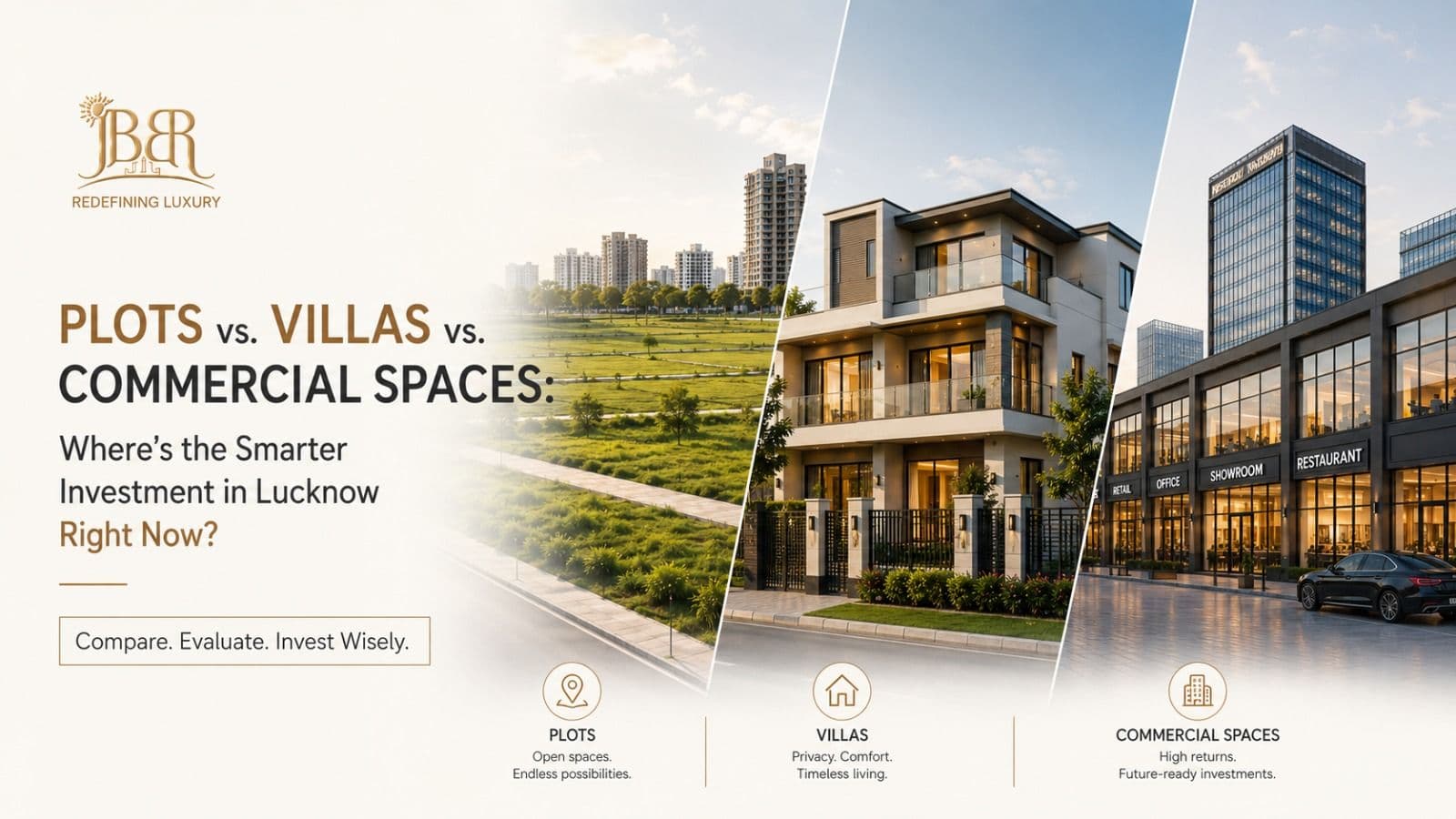
If you've been tracking Lucknow's property market, you already know the city is changing fast. New expressways, a growing IT and healthcare workforce, and rising demand from NRIs and out-of-city investors have made Lucknow one of North India's more interesting real estate stories. But the question most buyers actually struggle with isn't whether to invest — it's where.
Should you buy a plot and build later? Go for a ready villa? Or put your money into commercial space and earn rental income from day one?
Each of these can be the best investment option in Lucknow real estate, depending on your budget, timeline, and what you actually want from the investment — capital growth, rental income, or a mix of both. Let's break it down in plain terms.
Breaking Down the Three Investment Routes
Before comparing numbers, it helps to understand what you're actually choosing between. A plot is raw land — you're buying pure potential, with the freedom to build later or simply hold it as it appreciates. A villa is a ready, livable asset — you get immediate use, rental potential, and a lifestyle upgrade from day one. A commercial space is built purely for income — shops, offices, and co-working units that generate rent from tenants rather than personal use. Each one plays a different role in a portfolio, and the "best" one depends entirely on whether you're chasing growth, lifestyle, or cash flow.
Plots: Lower Entry Cost, Higher Patience Required
Plots remain the most popular entry point for first-time real estate investors in Lucknow, and it's easy to see why.
What works in favour of plots:
● Lower upfront cost compared to built-up properties
● Land typically appreciates faster than construction, especially in developing localities
● Full flexibility — build a home, lease it out, or simply hold and resell
● No maintenance costs while the plot sits vacant
What to watch out for:
● Zero rental income until you build something on it
● Appreciation depends heavily on location and legal approval status
● Longer horizon; plots usually reward patience over 5–10 years, not 1–2
Plots suit the long game. Areas seeing infrastructure push — new roads, upcoming commercial hubs, proximity to the airport or expressway — tend to see the sharpest appreciation.
Villas: Lifestyle Meets Long-Term Value
Villas sit in an interesting middle ground. You're not just buying an asset, you're buying a lifestyle — and in Lucknow's case, that lifestyle is increasingly in demand.
What works in favour of villas:
● Immediate usability — move in, rent out, or use as a second home
● Strong demand from professionals and families wanting more space and privacy than apartments offer
● Gated villa communities often come with better security, landscaping, and amenities, which supports resale value
● Rental yields tend to be healthier than plots since the property is livable from day one
What to watch out for:
● Higher upfront investment than plots
● Ongoing maintenance and society charges
● Appreciation is steadier, not explosive — a slow-and-steady asset rather than a quick multiplier
If your goal is a mix of lifestyle upgrade and long-term wealth, a well-located villa is hard to beat.
Commercial Spaces: Built for Cash Flow
If your priority is income rather than appreciation, commercial real estate changes the equation entirely.
What works in favour of commercial spaces:
● Rental yields are typically much higher than residential — often 6-9% annually compared to 2-3% for residential
● Longer lease tenures mean more stable, predictable income
● Growing business activity in Lucknow — retail, offices, co-working spaces — is fueling steady demand
● Commercial tenants often bear a larger share of maintenance costs
What to watch out for:
● Higher entry cost and stricter loan terms
● Vacancy periods can hurt more, since commercial income is lumpier than residential
● Location is everything — a commercial unit in a low-footfall area can sit empty for months
Commercial spaces suit investors who already have some real estate exposure and now want their money working actively, generating monthly returns rather than waiting years for appreciation.
So, Which One Actually Wins? — The Full Comparison
Honestly — it depends on what you're optimizing for. Here's a detailed, side-by-side look at how plots, villas, and commercial spaces stack up on the factors that actually matter to an investor:
Parameter | Plots | Villas | Commercial Spaces |
Entry Cost | Lowest of the three | Moderate to high | Highest |
Rental Income | None (until built) | Moderate (2–3% yield) | High (6–9% yield) |
Appreciation Potential | Highest, long-term | Steady, moderate | Location-dependent, can be sharp |
Liquidity (ease of resale) | Moderate — depends on location and layout approval | Good — steady buyer demand | Lower — smaller buyer pool, longer sale cycles |
Loan/Financing Ease | Harder — plot-only loans have stricter terms | Easiest — standard home loans apply | Moderate — stricter eligibility, higher interest |
Maintenance/Holding Cost | Low (property tax only) | Moderate (society + upkeep) | Often borne partly by tenant |
Ideal Investment Horizon | 5–10 years | 5–7 years | 3–5 years (income-focused) |
Risk Level | Location and title-dependent | Low to moderate | Higher — vacancy risk |
GST/Legal Complexity | Low, but conversion rules apply | Low | Higher — GST on under-construction units |
Best Suited For | Long-term wealth builders, first-time investors | Families, lifestyle + steady growth seekers | Active income seekers, experienced investors |
Quick takeaway: If you want maximum long-term growth on a smaller budget, plots win. If you want a livable asset with steady appreciation and easier financing, villas win. If monthly cash flow is the priority and you can handle occasional vacancy risk, commercial space wins.
Many seasoned investors in Lucknow don't pick just one — they start with a plot in a high-growth pocket, add a villa for personal use or long-term rental, and later move into commercial once they have more capital to deploy.
Legal Checklist Before You Invest — Don't Skip This
Whichever option you choose, the real risk isn't picking the "wrong" asset type — it's picking the wrong paperwork. Run through this before you sign anything:
● RERA registration — Every Lucknow project should carry a valid UP RERA number. Check it yourself on the UP RERA portal and confirm the project name, builder name, and registration number all match the brochure or agreement.
● Approved layout, not just "developing area" — A plot in an LDA-approved (Lucknow Development Authority) layout is legally far safer than one on unapproved or agricultural land, even if the unapproved option looks cheaper.
● Freehold vs leasehold status — Know exactly what you're buying. Freehold gives full ownership of land and structure; leasehold comes with time-bound rights, which matters a lot for resale later.
● Land-use conversion isn't automatic — Eyeing a plot for future commercial use? Don't assume conversion is easy. It needs a formal Change of Land Use (CLU) approval from the LDA — confirm this before buying, not after.
● Title deed and encumbrance certificate — Confirm clear, disputed-free ownership, with no pending loan or legal claim on the property.
● Registration and stamp duty costs — These vary by property type, and commercial units also attract GST on under-construction purchases, which many buyers only discover at the final payment stage.
A day spent on these checks is what separates a safe investment from a stuck one.
The One Factor That Decides Everything
Here's something most comparison articles skip: the property type you pick matters less than who you're buying it from. A plot in the "right" location can still turn into a legal headache if the layout isn't approved. A villa can look perfect on paper and still face possession delays. Commercial space can sit vacant simply because the builder chose a low-footfall location without thinking it through.
This is where JBBR comes in. With over two decades of building across Lucknow's residential and commercial landscape, JBBR's projects are planned around the same fundamentals this article has walked through — approved layouts, clear titles, and locations picked for real, long-term growth rather than a quick sales pitch. Every project carries the paperwork to back it up, so you're not left doing the legal homework alone.
Whether you're leaning toward a plot, a villa, or commercial space, talk to JBBR before you finalize anything. Get in touch with JBBR to see current opportunities that fit your investment goals.
Frequently Asked Questions
1. What is currently the best investment option in Lucknow real estate — plots, villas, or commercial?
There's no single right answer — it depends on your goals. Plots suit long-term, lower-budget investors. Villas work well if you want lifestyle value along with steady appreciation. Commercial spaces are ideal if you want regular rental income. Many investors combine two or more based on their budget and timeline.
2. How much can I expect a plot in Lucknow to appreciate over 5 years?
It varies a lot by location. Plots in developing corridors with upcoming infrastructure — new roads, metro extensions, commercial hubs — tend to see the strongest appreciation. A well-located plot in a RERA-approved layout typically outperforms unplanned land significantly.
3. Is it safer to invest in a ready villa instead of a plot?
"Safer" depends on what you're worried about. Villas remove construction-related uncertainty since you're buying a finished, livable asset. Plots carry more flexibility but need careful location research since appreciation isn't guaranteed everywhere.
4. What rental returns can I expect from commercial property in Lucknow?
Commercial spaces generally offer higher rental yields than residential, often in the 6-9% range annually, compared to 2-3% for homes. Actual returns depend heavily on footfall, location, and tenant demand in that specific micro-market.
5. Do I need a large budget to start investing in Lucknow real estate?
Not necessarily. Plots are usually the most accessible entry point in terms of budget. Villas and commercial spaces need higher capital but offer either lifestyle value or active income in return.
6. How do I make sure my investment is legally safe?
Always verify RERA registration, clear land titles, and the builder's past project delivery record before investing. Working with an established, transparent builder significantly reduces legal and delivery risks.
7. How do I actually check a project's RERA registration in Lucknow?
Visit the UP RERA portal and search using the project name or registration number. Confirm the builder's name, project name, and promised possession date match exactly what's in your agreement — mismatches are a red flag.
8. Can I convert a residential plot into commercial use later?
Not automatically. It requires a formal Change of Land Use (CLU) approval from the Lucknow Development Authority. Never buy assuming conversion will be easy — confirm zoning and approval feasibility before you commit.